
The Winemaker Helping Shape Vermont Wine
At La Montañuela, Camila Carrillo is building something rooted in land, legacy, and place.
Written by Joseph Puente
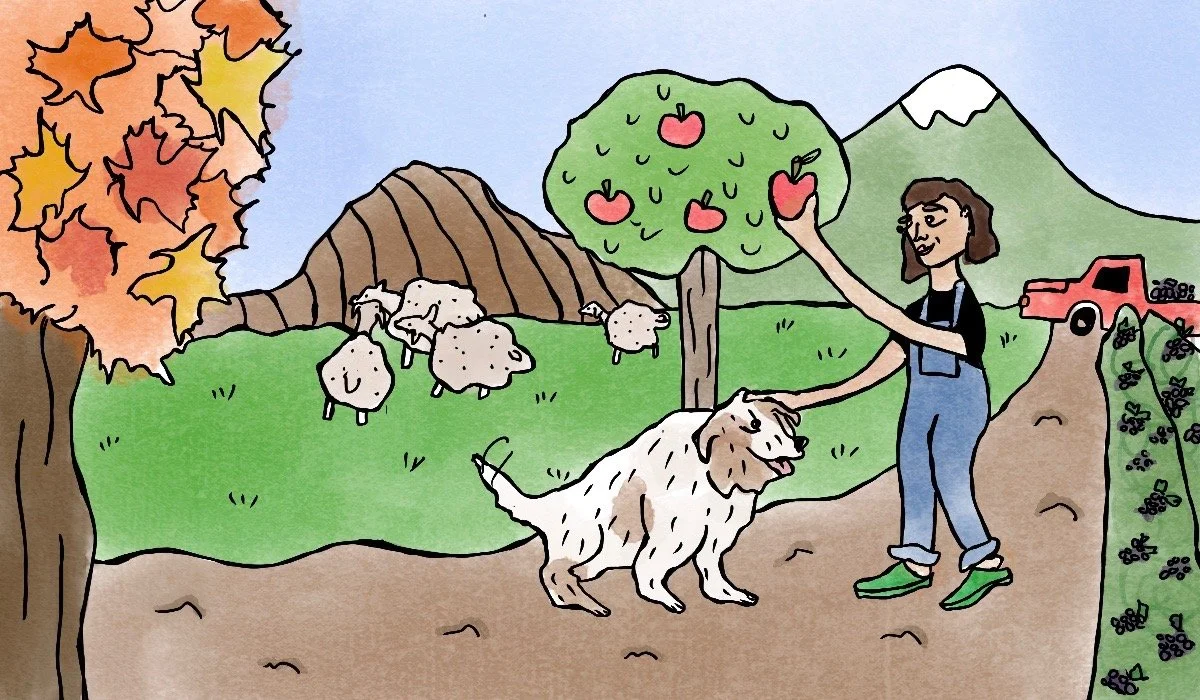
Illustration by Cerise Zelenetz

On a cool September morning in Vermont’s Champlain Valley, winemaker Camila Carrillo moves through rows of Marquette vines in her Hinesburg vineyard. Her Australian Shepherd, Blue, lies stretched in the shade beneath tangled vines and leaves, unbothered by the clusters of unfamiliar voices around him. Nearby, volunteers—some longtime friends and others who responded to an open call on Instagram—pick bunches of grapes and fill harvest bins.
In past years, Carrillo leaned on family and close friends during harvest, but this season she decided to open the process up. Volunteers from Burlington to Boston spent the morning in the vineyard, learning about her culture, her approach to winemaking, and the man who first taught her what it means to be a steward of the land.
"My abuelo was such a huge part of my upbringing and helped me become who I am today," said Carrillo.
Her grandfather, Luis Enrique Carrillo, didn’t grow grapes or make wine. Instead, he planted the seed and instilled the values of la familia, la cultura, and la tierra. His legacy and influence on her agricultural career are posthumously celebrated in La Montañuela, the name of both her winemaking project and her abuelo's beloved farm outside Caracas, Venezuela.
"He was always curious about my job as a winemaker and reminded me about patience, and the privilege of having land to nurture," she said. "When I walked the farm, I felt connected to him and the land. I think it was walking the property as a young girl and being fascinated by the flowers, plantains, and other root vegetables he grew."
Carrillo's approach to winemaking mirrors Vermont’s landscape: nourishing yet unpredictable. Her calm, steady disposition reflects the resilience of the vines and the temperament of a winemaker shaped by the state’s unpredictable seasons.
"We work with nature, not against—we're always adjusting," says Carrillo.
Hunched over, harvest hands clip bunches of Marquette one row at a time, forearms supporting wild stems that crisscross and bury the grapes. As the sun climbs higher, Carrillo pauses to take in the rolling hills and open farmland. The scent of her abuelo's cologne lingers faintly through the wind, a memory of the tropical sun he once worked beneath.
She remembers early morning walks alongside him and the bright red fruit dangling from the tomato de árbol (tomato tree).
The day after harvest, I joined her at Domaine La Garagista in Barnard, Vermont, where she and a small team destemmed and pressed the grapes. The property, owned by Deirdre Heekin and Caleb Barber, is a cornerstone of Vermont’s wine culture and has become a home base for Carrillo’s creative evolution. Since 2017, Heekin and Barker have mentored her, offering not only technical guidance but space for her intuition to thrive.
What she didn’t learn from a classroom, she gained in vineyards across the world.
After high school, while her friends enrolled in college, Carrillo traveled, working internships in California, Italy, Australia, and Argentina. Producers like Paul Hobbs in Mendoza and Chantal Forthun at Flowers Winery gave her hands-on training in the business and scientific elements of being a successful winemaker. Those experiences eventually brought her home to Vermont, where she apprenticed under Heekin and Barber.
"I had to leave Vermont to have an appreciation of what was going on here," said Carrillo. "One of the reasons I love working with Deirdre is her approach to wine that requires more sensory observation and attention to what's growing around the vine. Winemaking begins in the vineyard; it's a connection with the land that can be tasted in the wine. Healthy vineyards grow healthy fruit."

Deirdre’s mentorship has prepared Carrillo for both the creative and environmental challenges ahead. Together, they’ve adapted to Vermont’s increasingly humid summers, a direct effect of climate change that heightens disease pressure and the risk of powdery mildew.
Unlike European Vitis vinifera varieties such as Pinot Noir and Chardonnay, the hybrids Carrillo grows, Marquette, Frontenac Blanc, Verona, and Itasca, are cold-hardy, disease-resistant, and deeply expressive of Vermont’s terroir. Through organic and biodynamic farming, she transforms them into wines that embody resilience, adaptability, and respect for place.
Now in her eighth vintage, Carrillo’s lineup reflects both technical skill and emotional storytelling. There’s a light, citrusy sparkling wine made from Itasca, suited for a summer day, and a Frontenac Blanc sourced from a vineyard in Perkinsville that she plans to grow on her own land soon.
Her most significant contribution to Vermont’s wine culture is a series of oxidative wines called Flor del Campo. Tucked into a basement corner below the main production floor at La Garagista sits a century-old Amontillado barrel donated by Ramiro Ibáñez, the celebrated Jerez winemaker. Carrillo uses the solera system, replenishing the barrel with younger wine until she reaches a desired expression.
“Cecilia,” named after her grandmother, is made from one hundred percent La Crescent grapes and is unmistakably Vermont. The wine opens with notes of white flowers, nuts, and honey, and finishes with a hint reminiscent of a maple creemee, a nod to the state itself.
“What I’ve learned from Camila, and always admired about her, is that she has stayed true to herself and her own rhythms,” said Heekin. “She’s taken the ethos that we as humans are part of nature, we are nature. Our role in viticulture is to be part of the process, not to separate ourselves by leading with ego. It’s about working in tandem with, and collaborating with, the natural world and what it offers. In terms of wine, it’s about what the grapes want to become.”
In 2018, during her first year at La Garagista, Carrillo also tried her hand at cider.
“Working with apples in Vermont is a great way for young people to start out,” said Heekin. Apples were a natural fit, and Carrillo produced a sparkling cider that was released in 2019.
That same year, Carrillo received news of her grandfather’s passing. Though they spoke often while she traveled the world, more than a decade had passed since she last visited the farm that inspired her dreams. The memories of the farm, she says, had faded like ink from subconscious thoughts written in a travel-worn notebook.
La Montañuela was born from that loss. In 2020, Heekin and Carrillo were approached by a grower in Hinesburg to take over their vineyard. The opportunity gave Carrillo land to farm herself and to launch her flagship wine, Rocío, named after her mother. Made from Marquette grapes, Rocío is lively and earthy, fruit-forward with notes of ripe blackberry and raspberry, finished with a cooling touch of green stems.
“A lot of people in her position might have moved faster, given the number of opportunities that came her way,” said Heekin. “She’s very strategic and knows what’s right for her career. What I’ve been able to offer is support, helping her slow down and assess each opportunity. She’s taken what she learned here and applied it with her own creativity to produce the wine she wants to make.”
Sitting in the passenger seat of Carrillo’s heavy-duty Chevrolet truck, I thought about the future of Vermont agriculture and what her work represents in a wine landscape still dominated by European varieties and narratives. Over the course of our conversations, we spoke about immigration, Latinidad, family, and our shared admiration for Bad Bunny.
Each topic circled back to the same truth: her work is not just about wine. It’s about legacy, creating space where none existed before, and making something that carries memory forward.
“The wines are love letters, ways to connect and pay tribute to my family.”
