
How Impressionist Artists Paved the Way for Declassified French Wine
Why some of France’s most respected winemakers are choosing expression over regulation.
Written by Sophie Stuart
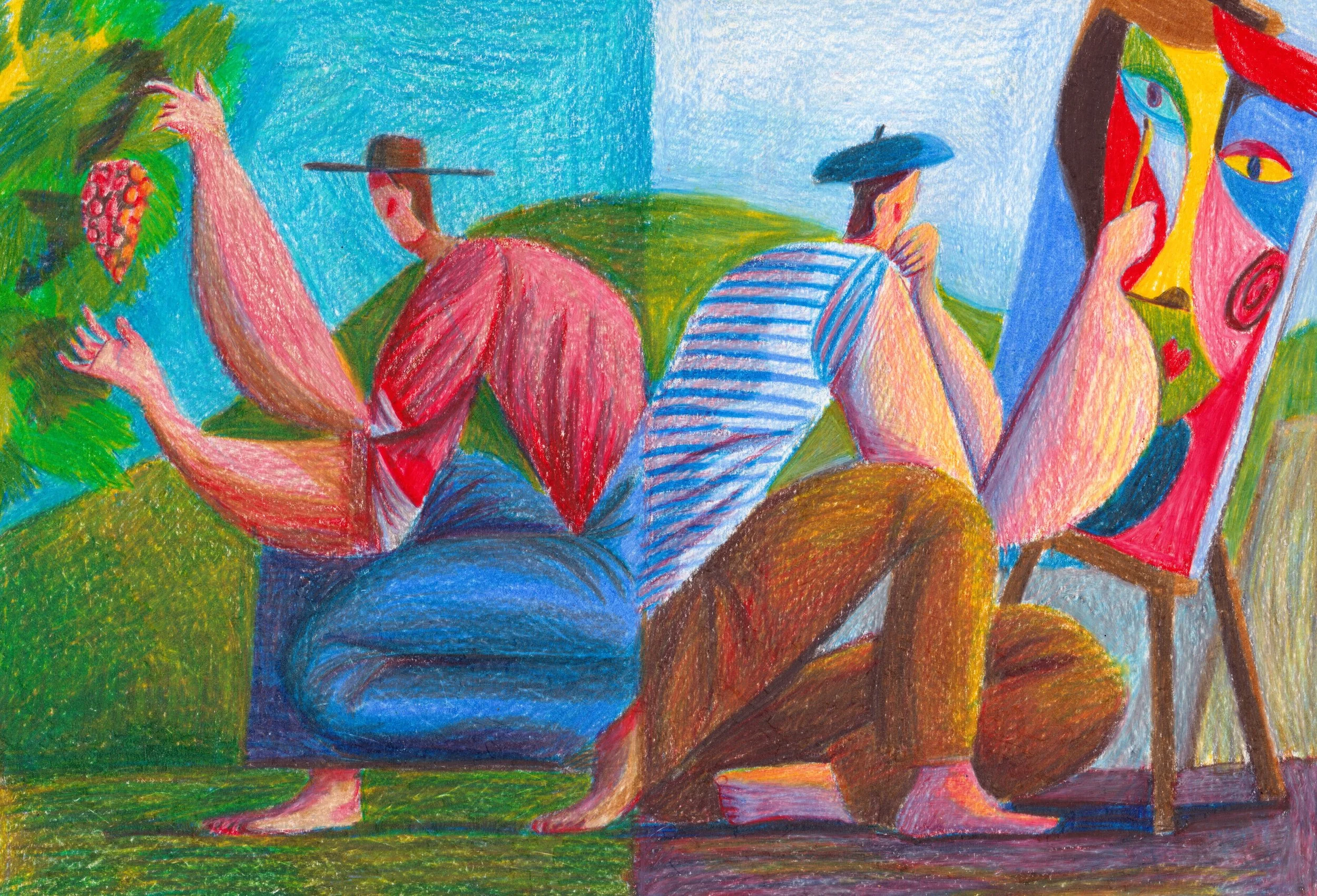
Artwork by Pat Thomas

A well-known quote by Pablo Picasso is, “Learn the rules like a pro, so you can break them like an artist.” Born to an artist father, Picasso studied art from the age of seven. Trained classically and prolific in Realism, he eventually broke from his training to pioneer his own style.
I’ve always found it mystifying to overhear a museum visitor remark on a piece by Picasso, ”My four year old could paint that.” These gestural, seemingly impulsive paintings are, in fact, the result of decades of work and study. Artists like Picasso spent years mastering form and technique before breaking from convention to create something authentic and remarkable.
In the 1860’s, when the impressionist movement began to take shape, a group of then-unknown artists—Claude Monet, Camille Pissarro, Pierre-Auguste Renoir, and Mary Cassatt—were repeatedly rejected by the Paris Salon, the juried exhibition that was responsible for awarding medals and defining what was considered “good” art. Their bright, ethereal work was often dismissed as unfinished. Meanwhile, artists favored by academic and institutional powers at the time included figures like Jean-Léon Gérôme and Gustave Courbet, whose historical and highly polished style aligned with prevailing standards. Frustrated, the Impressionists banded together to create their own independent exhibitions.
When describing the Impressionist movement and referencing the National Gallery exhibition Paris 1874: The Impressionist Movement, New York Times critic Jason Fargo writes, “It’s about institutions and reputations… It’s about whether cultural change is ever truly a clean handoff from the old to the new.” His observation captures not only the rise of the Impressionists, but also the story of anyone who rejects convention to pursue something unexpected and unfamiliar.
Taking a detour from tradition can often be misconstrued as a shortcut. The same tension between tradition and innovation is echoed far beyond visual arts—in music, writing, architecture, and even winemaking. The artists and winemakers we celebrate today are often the ones who mastered their craft while maintaining an individualized and authentic style that they stayed true to.
Similar to artistic institutions like the Académie des Beaux-Arts, France’s winemaking establishments have a history of regulation and control. In 1919, France passed laws legally protecting wine appellations by defining their geographic boundaries, laying the groundwork for the stricter production regulations that would follow. With the establishment of the INAO (National Institute of Origin and Quality) in 1935, regulations expanded to include specifics such as permitted grape varieties, yields, planting density, and harvest parameters. Overseen by the INAO, these rules were designed to preserve tradition and ensure quality. They also formalized terroir in legal terms protecting regional names, defining typicity, and giving consumers a reliable shorthand for origin. For many producers, appellation status provides legitimacy and collective market strength, anchoring value to geography rather than brand alone.
For decades, most French producers benefited from these regulations. Consumers could rely on the government to signal quality and origin, while producers used them to communicate regional typicity. At the same time, many producers still rely on appellation systems to communicate identity and maintain market recognition.

Over the last half-century, however, some producers have begun to feel constrained by aspects of the system. As climate shifts force winemakers to adjust harvest timing and vineyard practices, regulatory rigidity can become an obstacle to experimentation and adaptation. Climate pressure is only one factor—stylistic philosophy, farming approach, and market positioning are also driving some producers toward declassification.
Like the Impressionist movement before them, a small but visible number of winemakers are choosing—for stylistic, philosophical, or practical reasons—to step outside regulated winemaking systems. Notable producers across France have declassified their wines in pursuit of creative and agricultural freedom, questioning whether existing frameworks can evolve quickly enough to reflect modern viticulture.
That shift became especially visible when Château Lafleur, a top estate in Pomerol, recently announced it will no longer bottle under the Bordeaux and Pomerol appellations. The Guinaudeau family, which has farmed the estate since the 1980s, cited climate challenges among the key reasons behind the decision, writing, “Climate is changing fast and hard, that much is clear. The vintages 2015, 2019, and above all 2022, were all strong evidence of that. 2025 goes a step further. We must think, readapt, act.” For an estate of Lafleur’s stature, the move signals how even the most historically rooted producers are re-evaluating how best to express their place in a changing climate.
Benoît Courault, a winemaker in Anjou in the Loire Valley, produces wines from Chenin Blanc, Cabernet Franc, and Grolleau. Known for his meticulous approach, plowing with horses and applying techniques refined during years of study in Burgundy, that Burgundian influence shows clearly in the precision and structure of his wines.
By 2006, however, he had decided to step away from the appellation system, yet giving it “one last try” in 2007 before leaving it behind altogether. “The administrative constraints are far too heavy—and to defend what, exactly?” he says. “Nowadays, what they’re promoting are Cabernet d’Anjou and Crémant de Loire. That’s how the appellation is being ‘valued’: high yields, without highlighting the already classified terroirs.”
For Courault, the concern runs deeper. “No one really talks about the issue, and dry white wines are practically nonexistent on the market. Unfortunately, Anjou AOC is very large and run under the influence of the négociants and cooperatives.” His critique points to a broader tension with regulated systems: when scale and commercial priorities begin to shape the market, producers focused on site-specific expression can find themselves misaligned with the very framework meant to represent them.
In Burgundy, where Courault once refined his craft, similar tensions surfaced in different but equally telling ways. In Chablis, at Château de Béru, Athénaïs Béru now leads her family’s estate, crafting precise, expressive Chablis while also producing wines under her own label, Les vin d’Athénaïs. That second project gives her room to experiment with different varieties and techniques, often bottled under Vin de France, wines liberated from appellation constraint.
The wines of producers like Lafleur, Courault, and Berú, don’t reject structure outright. They reflect choices made in response to climate and vineyard conditions, choices that may not always align neatly with regulatory templates. Much like the canvases of Monet or Renoir, they prioritize lived conditions over fixed ideals.
The INAO framework was built to safeguard identity, and for many producers it continues to do so effectively. It protects names, signals origin, and provides a shared standard. The tension emerges when the mechanisms designed to preserve typicity struggle to keep pace with agricultural and environmental change.
The Impressionists didn’t reject the academy because they lacked discipline. They rejected it after mastering it. Their departure wasn’t a dismissal of tradition, but an acknowledgement that the prevailing standards no longer reflected what they were observing. The same dynamic is unfolding in wine. The most consequential departures from the appellation system are often made by producers who understand it deeply, and who question whether its structures still reflect the landscapes they were built to protect.
The best winemakers, like the most influential artists, are those who first master the rules and, then, when necessary, challenge them.
