
Why a Japanese Sake Giant Bet on the Hudson Valley
Two hours north of Manhattan, Dassai built a 55,000-square-foot brewery that’s helping reshape how Americans drink sake.
Written by Eric Do
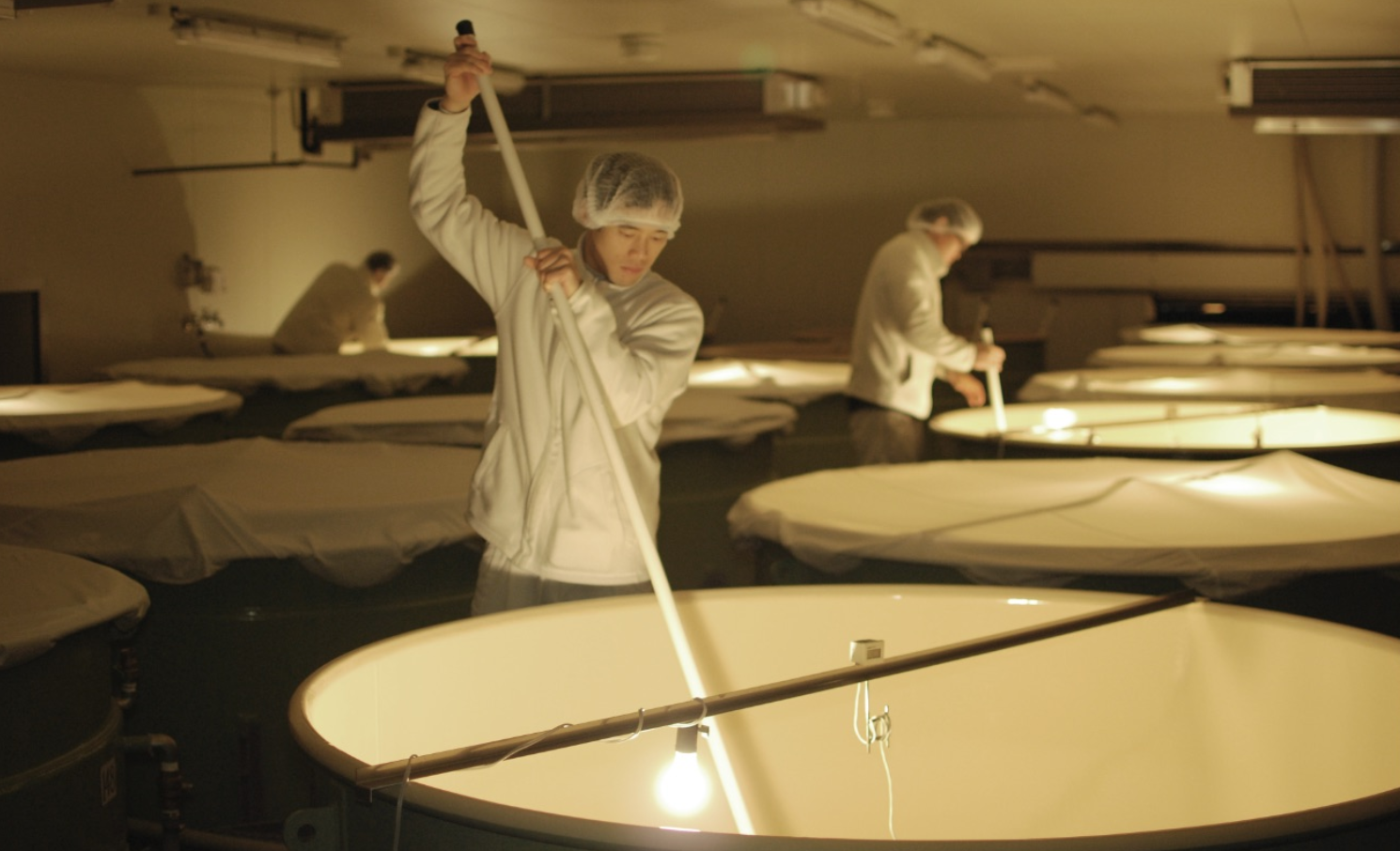
Photo courtesy of Dassai.
If you were asked where one of Japan’s most influential sake producers would open its first U.S. brewery, a quiet stretch along the Hudson River, two hours north of Manhattan, probably wouldn’t make your short list. And likely not even your long list. But that’s exactly where Dassai, one of Japan’s most respected sake producers, chose to build a 55,000-square-foot brewery and tasting room.
Sake has been making a big splash in the U.S., expanding beyond the confines of the Japanese dining scene into breweries, bars, and shops. There are now roughly two dozen sake breweries across the U.S., a sharp increase over the past decade, with three of them located in New York. The state’s modern wave of sake production accelerated in 2018 with Brooklyn Kura and has since expanded to include Kato Sake Works and, most recently, Dassai Blue.
U.S.-based sake breweries are challenging long-held notions of what sake can be. “American sake is not following the same trend [as Japanese sake], they’re figuring out what works for them,” says George Padilla, co-owner of Bin Bin Sake, a natural wine and sake shop. That approach has opened the door to experimentation, from the use of domestic ingredients to the production of lower-ABV, fruit-forward, and sparkling styles. As sake becomes more sought-after, consumers are beginning to see how it fits into their everyday lives, exploring its range of flavors and broadening its role at the table.
North America accounts for 29% of sake’s total export value, with import value up 27% year-over-year. As with the premiumization of beer and wine, sake is entering a craft phase, with exporters reporting a 26% increase in average pricing over the past five years—signaling growing willingness to pay for higher-end bottles.
“In the past, many customers asked, ‘I’m making sushi at home today. Which sake do you recommend?’ But now, more and more customers are asking, ‘I’m having a BBQ tomorrow. Which sake should I get?’” said Sam Miyazawa, the beverage director of Japan Village, a Japanese grocer and specialty sake shop.
One brewery expanding its identity and global outreach is Dassai, a producer widely credited with shaping the modern premium sake movement.
Dassai’s story begins in Japan’s Yamaguchi Prefecture. The name itself translates to “otter festival,” a reference to the region’s history, when otters were said to catch fish and lay them along the shore as if displaying their bounty during a festival.
Founded in 1948, the brewery behind Dassai operated for decades as a small, locally-focused producer. By the 1970s, as Japan’s sake industry entered a prolonged decline and drinking habits began to shift, it faced the same pressures as many others—struggling to stand out in an increasingly crowded market.
When Hiroshi Sakurai took over the family brewery in the 1980s, he inherited a struggling, largely undifferentiated operation. At the time, much of Japan’s sake market was dominated by inexpensive, mass-produced products sold at steep discounts—an environment where smaller producers found it increasingly difficult to compete.
In an effort to differentiate, Sakurai reached a pivotal conclusion: if the focus shifted to quality, customers would follow. He decided to focus production on daiginjo sake after seeing similar success in the Shizuoka Prefecture. The shift required embracing a slower, more labor-intensive process reserved for sake’s highest grades. While everyday sake is typically made with less polished rice, daiginjo requires polishing down to 50 percent or less, resulting in a more subtle and nuanced flavor profile.
“At the time, our company only made sake for the local people to drink on a daily basis,” He said. “Based on our customer profile, we thought we couldn't sell daiginjo sake even if we made it.”
By 1999, Sakurai’s bet had paid off. Dassai became profitable, first gaining traction in Tokyo before expanding overseas—beginning with Taiwan and then New York in 2003. The brand quickly gained traction in New York, and its Junmai Daiginjo (“Junmai” referring to no brewer’s alcohol added) eventually grew into one of the best-selling premium sakes globally, now distributing to 45 countries. Domestic demand, however, lagged behind international growth. “[Japanese] demand will not be good for a while yet. We have no choice but to shift our focus overseas - more than ever before,” Sakurai said.
When Hiroshi Sakurai’s eldest son, Kazuhiro, joined the company in 2006, their sights were set on international expansion. “I gave him a year or so of in-house training and then immediately sent him to New York,” wrote Hiroshi Sakurai.
How did the small town of Hyde Park—with a population just over twenty thousand—become Dassai’s new home? The answer lies next door: the Culinary Institute of America.
Sakurai developed a relationship with the CIA’s former president, Timothy Ryan, as the Institute expanded its Japanese cuisine and sake programs. The opportunity came when, as Sakurai recalled, "One day, I heard from the Culinary Institute of America that there was a piece of land available nearby, so I thought this was a great opportunity.”
Construction was initially delayed due to Covid, but Dassai Blue ultimately opened in 2023 after a multi-year build. Even before the first bottle was made, Sakurai had high expectations for the new brewery. The name reflects that ambition, drawn from a Japanese proverb meaning “blue is bluer than indigo.” The goal wasn’t simply to replicate Dassai’s sake in the U.S., but to “brew a more superior product than our sake in Japan.”
Brewing in a new place, however, introduced new variables. “Even with the same rice and the same brewing process, the flavor can change dramatically if the water, soil, and climate change,” says Miyazawa. While yeast and koji can be transported easily from Japan, water and rice presented the biggest challenges.
The Hudson Valley’s water proved to be a strength. Walker described it as the “champagne of water.” Rice, however, was more complex. Dassai exclusively uses Yamada Nishiki, often referred to as “the king of sake rice,” which is known to be difficult to cultivate and increasingly expensive to source from Japan. That challenge led to a partnership with Isbell Farms in Arkansas, a respected U.S. sake rice producer of more than fifteen years.
Even with the same rice variety and a high-quality water source, differences emerged. “New York [water] has more minerality…Yamada Nishiki from Arkansas has more hardness… which takes more time to [intake] water,” says Walker. However, Sakurai says, despite these differences, “the philosophy, skills, and technique remain the same.”
Refining the recipe took years before Dassai Blue was satisfied with the results. Beginning in January 2026, “all production lots are now brewed using 100% Arkansas rice,” said Walker.
Since opening in 2023, Dassai Blue has already doubled its production volume, riding growing consumer interest and familiarity with sake. In recent years, Padilla says, “[there’s] less bias and skepticism of domestic sake and more acceptance.”
In other words, “sake is no longer Japanese sake, but simply sake,” says Miyazawa.