
Should New York Wine Shops Be Allowed to Sell Non-Alcoholic Products?
Outdated laws, growing demand, and the unintended consequences facing independent retailers.
Written by Vicki Denig
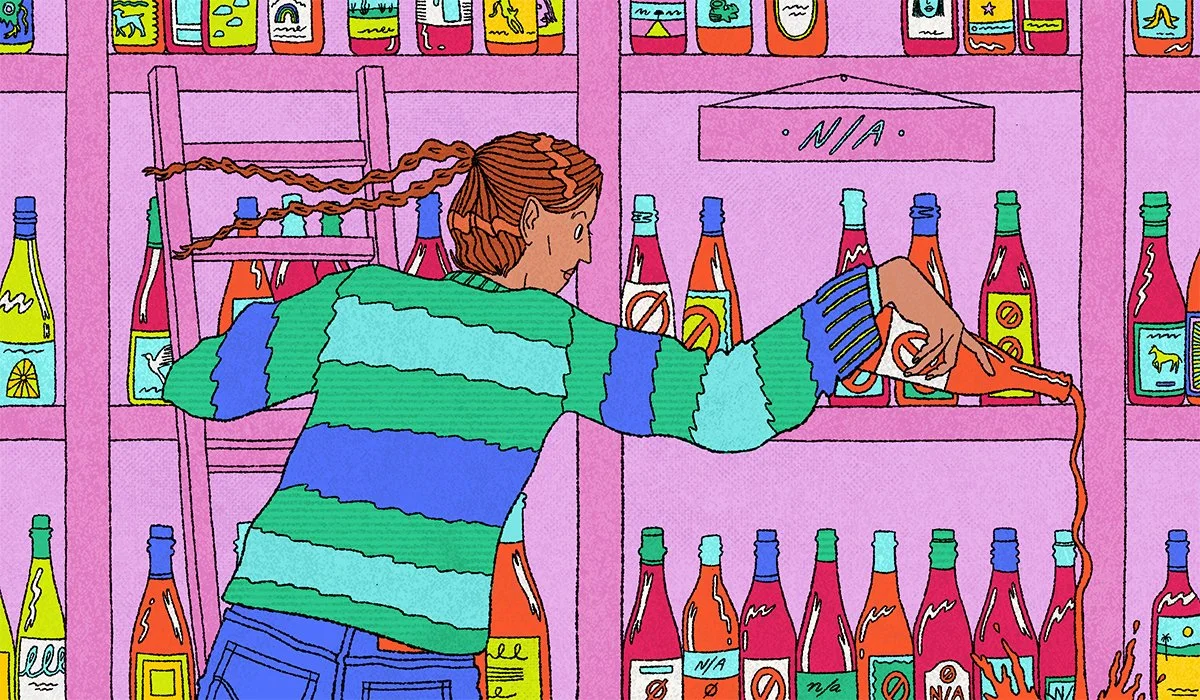
Illustration by Casey Beifuss

If you’ve ever walked into a New York wine shop looking for non-alcoholic alternatives, you’ve likely left confused, and definitely empty handed. Despite the increased number of moderation-curious drinkers—along with the skyrocketing growth of the N/A category as a whole—New York wine and shops are still legally barred from selling non-alcoholic products.
According to the State Liquor Authority, commonly referred to as the SLA, beverages under 0.5% ABV are not legally permitted to be sold in wine and liquor shops, a restriction that dates back to the late 1930s. Until recently, that same restriction also applied to the sale of corkscrews, wine glasses, or wine gift bags, which changed with the passing of Section 63 of the ABC Law act in 2016. (SWURL reached out to the SLA for commentary surrounding the historical context of these laws, as well as their relevance today, and did not receive answers to the questions.)
Rather than getting stuck on the logic of century-old legislation, we took to the streets and spoke with a handful of colleagues—including retailers and non-alcoholic beverage producers alike—to understand the current state of the N/A market in New York, as well as how these laws affect their customers, market growth, and overall business today. What emerged was a shared sense of frustrations, paired with an even more complicated question: would changing the law actually benefit the ecosystem it’s meant to serve?
Young Stowe, co-founder of Brooklyn-based Unified Ferments, explains that his non-alcoholic products are subject to the same rules as Coke and Pepsi—meaning they can legally be sold in gas stations, grocery stores, and similar shops. Sean Goldsmith, co-founder of the non-alcoholic brand Lapo’s, echoes this point, citing independent grocers, local chains, and dedicated non-alcoholic bottle shops as the primary retail homes for his products. He even notes New York as one of the brand’s strongest states in terms of sales, despite the restrictive laws.
From a production standpoint, Stowe notes that allowing non-alcoholic alternatives into wine and liquor shops would largely benefit his business. “Having more spots to sell into is a boon, and we've had a lot of success at wine-focused stores in states outside of New York,” he says, adding that a change in law would also give Skurnik, their New York distributor, a wider field of play thanks to their strong existing relationships with local wine shops. Goldsmith agrees, affirming that he doesn’t see any particular downsides. That said, the way in which such products would be marketed is up for discussion.
“One of the biggest challenges when launching with new retailers is ‘how will we show up on the shelf?’” Goldsmith reveals, pointing to the confusion that often surrounds placement and marketing of non-alcoholic products in shops without dedicated areas. “Sometimes you'll find Lapo's on the shelf next to kombucha, sometimes it's next to mixers, and other times it's with N/A beer—that takes some time to work out,” he says. In wine and spirits shops, however, Goldsmith imagines that non-alcoholic products would be merchandised more clearly, benefitting not only the producer, but the shops’ customers as well.
Keith Pulitano, Head of Wine Buying at lower Manhattan-based bottle shop Magazzino, reveals that customers are regularly surprised to learn that the shop cannot legally carry non-alcoholic products, leaving them puzzled—and even worse, without the bottles they were seeking out. “I think it would be beneficial to be able to carry whatever we see fit, whether that’s a collection of imported sparkling waters or weird small-batch ferments,” Pulitano says. “The ability to sell non-wine items could only be of benefit to our narrowly permitted scope.”
Still, the question of product quality comes into play. Pulitano explains that he doesn’t find the majority of non-alcoholic wines, particularly those that undergo the dealcoholization process, to align with the ethos of the shop. “They’re industrial, mass-produced bottles made with chemical processes,” he says. Rather, he’d be interested in products made with organic materials that are both compelling and delicious. “Financially, the result would be negligible, but the idea that we cannot is absurd,” he adds, suggesting the reasoning behind the law lies in post-Prohibition ideology meant to “protect the people,” when in reality, the legislation primarily benefits mega distributors, and in turn, the lobbies.

Pulitano breaks it down here. “Although these restrictions are often described as consumer protection, in practice they primarily benefit large distributors by ensuring wine/liquor stores can only sell products that must be purchased through them, preserving their volume and shelf dominance,” he says. Translation? In reality, the law harms consumers by limiting their selection, while also restricting the flexibility of smaller distributors by reinforcing scale advantages they cannot compete with—all while offering no meaningful consumer protection or justification to boot.
Turns out Pulitano isn’t alone in that thinking. Michael Faircloth, owner of Vinyl Wine on New York’s Upper East Side, feels similarly but from a different angle. “Would wine shops benefit from selling non-alcoholic products? The simple answer is no,” he asserts, explaining that passing such a law would allow grocery stores to sell wine, which would ultimately hurt smaller retailers. Faircloth clarifies that main lobbying to change SLA laws in New York state currently stems from the grocery store Wegmans, who’s seeking to overturn the law that prohibits grocery stores from selling wine.
Faircloth notes that he regularly hears of wine retailers wishing they could sell non-alcoholic products—along with cheese, charcuterie, and the likings—but this ultimately would be a death wish. “There is no amount of sales you could gain from cigars, food, or non-alcoholic beverages that, as a small retail store in NY (especially suburban cities), would make up for the lost sales you'd have from every grocery store selling wine,” he says. Faircloth cites the neighborhood of Williamsburg, Brooklyn, as an example. “There are already multiple wine shops for sale in that area because they're struggling—imagine if Whole Foods started selling wine there, too?”
Moreover, Faircloth notes that the reason that New York has such great wine shop culture, and not chains like Total Wine, is because the grocery store law prohibits chains from having licenses. “No wine store should want this to happen—and I can tell you from firsthand experience that non-alcoholic sales are nowhere near what people may think they’re missing out on.” (Note: Faircloth owns a small craft beer shop, Vinyl Beer, next to his wine store, which is permitted to sell non-alcoholic alternatives).
Though not all producers feel the same. Chris Furnari, communications lead for Athletic Brewing Company, believes that consumer access to non-alcoholic beer should be just as convenient as any other beverage, and that local laws should reflect modern drinking behaviors. “As consumer preferences continue to evolve, and more drinkers look to moderate their alcohol intake, expanding the availability of N/A beer helps meet growing demand, normalize adoption, and support those who approach drinking occasions with greater intention and balance,” he says, adding that broader access benefits customers, retailers, and communities alike.
If given the opportunity, Goldsmith says he’d absolutely jump at the chance to be stocked in wine and liquor shops. “No question—more than 90% of the people drinking our products drink alcohol, so they’re already shopping in wine/liquor stores,” he says. While Stowe shares the enthusiasm, but with a caveat similar to Faircloth’s concerns. “We hate the idea of spots stocking us (or any other N/A offering) out of some sense of market compulsion,” he says. “We'd rather someone not stock us than place one order and let it sit around for months.”
Though Stowe is no stranger to the broader legislative fears raised by Faircloth. “I fail to see any harm in wine stores stocking N/A products; that said, it seems some of the legislation currently up for discussion could also allow for wine sales in grocery stores, which could have a massive negative impact on NY wine and spirit stores,” he says, affirming that he’d hate to see anything negatively impact the “ecosystem of excellent wine stores” across the city. On the other hand, Stowe does believe that businesses should be able to make decisions for themselves—though at what cost?
Above all, Faircloth reiterates the importance of understanding how consequential it could be for such legislation to pass allowing wine shops to sell non-alcoholic products, specifically with the power of Wegman’s leading the competing lobby. “Selling non-alcoholic products is not going to feel like any sort of consolation prize,” he says. “It's going to result in a blood bath for indie stores across the state.”
