
How Chase Sinzer Is Building New York’s Most Exciting Restaurants
At Claud, Penny, and Stars, Chase Sinzer is proving that exceptional food, deep wine cellars, and hospitality don’t need to come with stiffness or pretension.
Written by Nathan Bodenstein
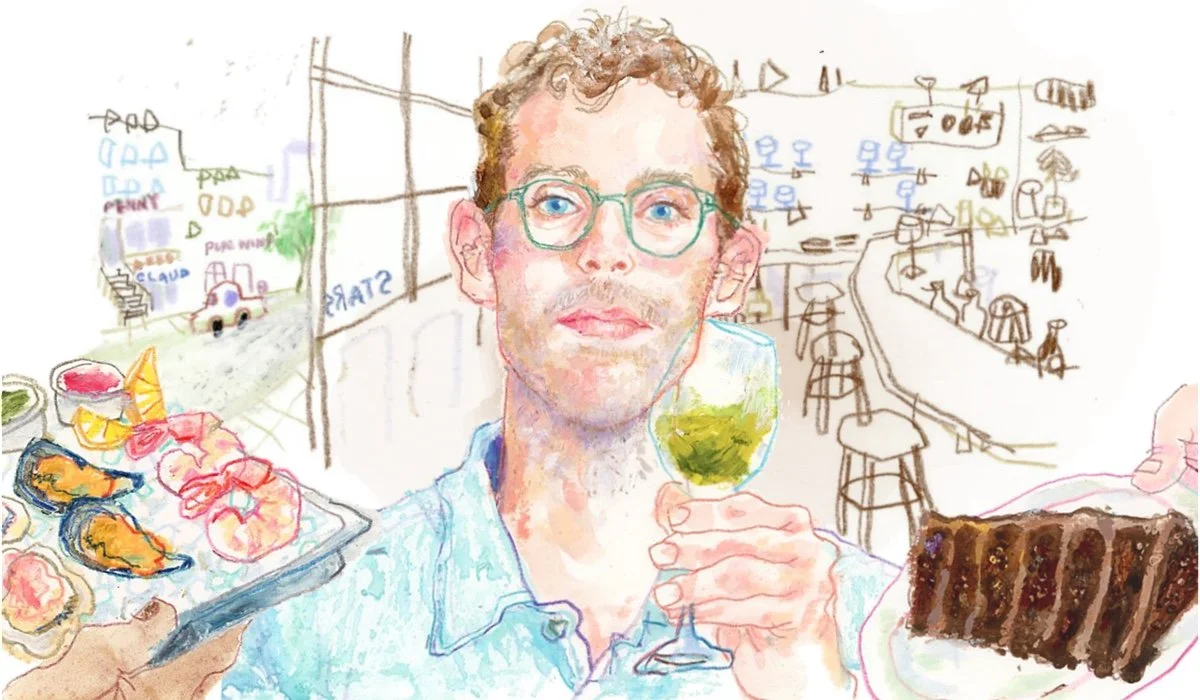
Artwork by Sang Pak
In the East Village, Claud, Penny, and Stars are not successful solely because their wine lists are among the most compelling in New York. Yes, they have bottles of Dauvissat, Raveneau, and Tissot with the kind of vintage depth that can excite the nerdiest of wine drinkers. But what makes this group of restaurants and wine bars feel so special is not just what’s in the cellar. It’s the way restaurateur Chase Sinzer understands how exceptional restaurants should feel.
Across these three establishments, there is a shared standard: food with a clear point of view, wine lists that balance affordability with depth, and rooms that feel meticulously designed without looking like a copy-paste of whatever restaurant style is currently in fashion. Each place has its own purpose and identity, but all three reflect a larger idea: hard-to-find wine, serious food, and thoughtful hospitality don’t require stiffness or pretension.
For many, Chase Sinzer is best known as a wine person, which is fair considering his resume working at Maialino, Momofuku Ko, and Crush Wine. As the co-owner behind Claud, Penny, and Stars, he has been pivotal in propelling their wine programs into some of the most exciting in the country.
But spend time talking with Sinzer and wine facts are rarely where the conversation goes. He talks about his team, the way people want to dine now, wine culture, and whatever he’s excited about in that particular moment—but if you want to get technical, he’ll make sure you’re taken care of.
What seems to matter more to him than encyclopedic knowledge is how all of that information gets put to work: a sommelier who’s excited and wants the guests to have a great evening, and creating a room where people feel at ease. The wine can be world-class, but the experience doesn’t have to feel intimidating.
“If it was stressful or overwrought or didn’t feel relaxed inside, we’d rather make a technical mistake than an emotional one. That's a Danny [Meyer] thing,” says Sinzer, referring to his time spent working within the world of Union Square Hospitality Group. “49% is technical. 51% is emotional.”
It’s something that he tries to instill in his own teams. Wine knowledge matters and table service matters. That’s not a question. But for Sinzer, the technical side of the job only works if it's balanced with an ability to read the room.
“I’m always talking with the team about the importance of making a connection with the people that come in to dine or drink with us,” he says. “Technical skills, whether it is wine knowledge or table service, are important, for sure. But emotional intelligence? That’s the thing.”
During his time at Ko, he learned that through his own mistakes. He remembers giving a big pre-service speech before a VIP came in. He wanted everything to be perfect, and at that point in his career, he prided himself on not dropping glasses or making mistakes. Then, come 5:30 p.m., the VIP sat down, and with the dining room quiet, he broke six glasses.
“I went up to them, made a joke, they laughed, and we all moved on,” Sinzer says. “Being able to have a technically precise service is great but reading the room and not making it weird or uncomfortable for your guests is even more important, and can help you recover from the mistake itself.”
A wine can be served in the perfect wine glass at the right time ahead of the food, and still miss if the guest feels rushed or out of place. At a Sinzer restaurant, guests stop thinking about the service and simply feel taken care of. His understanding of how that comes to be—and why it’s so important—is part of what makes his restaurants so successful.
Sinzer’s hospitality education began in northern New Jersey at The Grill, a roadside restaurant opened by his mother and uncle, not to be confused with the Major Food Group restaurant with the same name. The menu was simple: hamburgers and hot dogs. On opening night, when he was around eight years old, he remembers watching the room fill faster than his family expected. His parents were overwhelmed, and the restaurant was busy. So, without being asked, he stepped behind the cash register. It was the first time he realized that restaurants were something he was really interested in.
As he got older, he started analyzing cookbooks by French masters like Alain Ducasse and Joël Robuchon, lessons that were followed by attempts at making hollandaise and béarnaise sauce on a double boiler at 5:30 a.m. But he learned the most from meals he watched his mother and grandmother cook on instinct alone.
“They were very New Jersey, excellent cooks, meaning there’s no recipes. There’s no cutting boards,” he says. “They shave it like when they’re in prison—they cut the garlic in their hand.”
But when wine first appeared at home on the dinner table, it wasn’t first-growth Bordeaux and grower Champagne. It was something more unique. It was California Chablis, or Carlo Rossi poured over ice.
Sinzer’s professional foray into food and wine kicked off after college, when he joined Union Square Hospitality Group. Founded by Danny Meyer, the group is behind some of New York’s most influential restaurants including Gramercy Tavern and Union Square Cafe. Former employees often talk about working in Meyer’s restaurants as an education in hospitality, and for Sinzer, that maxim held true. But when he reflects on that time, he spends just as much time talking about Kevin Richer, a general manager at Untitled, the now-closed restaurant in the Whitney Museum. It was Richer who showed him what generous leadership could look like on the floor.
“It wasn’t that he was catching you mess up,” Sinzer says. “It’s that he got you to believe he was on your side, and you were both working to be better together.”
In listening to him recount the lessons he learned from Richer, it’s hard not to hear the similarities to how Sinzer describes the work culture he’s trying to build at his own restaurants.
In 2012, when Sinzer arrived at Maialino, Union Square Hospitality Group’s neighborhood Italian spot then located inside the Gramercy Park Hotel, his wine education accelerated. Jeff Kellogg, who was Maialino’s wine director for much of Sinzer’s time here, and John Ragan, USHG’s corporate wine director, became two of the most influential figures in his growth. With their mentorship, Sinzer threw himself into Italian wine, learning the regions, producers, and history of the country. He studied for the Court of Master Sommeliers, tasted aged Barolo at prices that are impossibly low by today’s standards, and learned as much as he could from the people around him. But when he tells stories from that period, the specific bottles tend to fade into the background. Instead, he speaks about the lessons he learned in hospitality.
One night at Maialino, that lesson came into practice through a regular named Carl. He would sit down, look around, and eventually toss out a price point to Sinzer and ask him to open something.
“As a young sommelier, this was new territory. Lots of trust and a bigger budget than I’d seen,” Sinzer says. In that position, the inclination could be obvious: open the bottle you’ve been eying since it landed in the cellar and been dying to open, and as Sinzer says, “price point and style be damned.” But the lesson was the opposite.
“These guests are trusting you and they genuinely want you to try something that piques your interest, but the key is to optimize their happiness,” he says. “Sommeliers make guest experiences through picking the right wine for them. That is the primary objective. The additional benefit is that we get to taste that wine.”
It’s a principle that guides wine service at Claud, Penny, and Stars. The guest’s experience comes first, and the sommelier’s excitement matters as well. “Those priorities should never be inverted but they go hand-in-hand,” Sinzer says. “And it should be really fun.”
After leaving USHG in 2014, Sinzer spent the next eight years moving through different corners of the New York restaurant world, working in a range of roles, including head sommelier, wine director, and general manager. By the time he and chef-partner Joshua Pinsky opened Claud in 2022, he had seen the business from nearly every angle: the wine cellar, working the floor, and the operations behind it all. Claud’s success was followed by Penny in 2024 and Stars in 2025.
At Stars, Sinzer’s newest wine bar concept in the East Village, the barrier to entry is refreshingly low. The popular “88 Bottles Under $88” isn’t just a pricing strategy—it’s a way of telling guests what kind of place they are in, and it reflects Stars’ role in a larger shift in wine culture. “When you highlight affordability,” Sinzer says, “you create the identity of the program.”
More recently, the team expanded that idea beyond evening hours. Stars now opens at 10 a.m. on weekends with coffee, tea, pastries, wine, and newly introduced half-bottle options. The half-bottle program acts as another access point for guests to explore different styles, producers, and price ranges without the full bottle commitment. “The beauty of a spot like Stars is that we’re very keen on trying to find ways to offer wine drinkers any entry point into their desired style and price,” Sinzer says.
When Sinzer began working in restaurants, quality wine mostly lived inside formal dining rooms, an environment that can feel alienating to casual drinkers. Today, people gather around bottles with a reverence unfamiliar to previous generations. Wine bars are not just places to have a glass before dinner—they’re where the whole night can take place.
The atmosphere is looser now, and the audience is certainly younger than ever before. Curiosity has begun replacing intimidation, and Sinzer has leaned into that shift, while preserving the standards that underpin ambitious wine programs. His restaurants are preserving the discipline of old-school fine dining, while removing the stiffness and superiority that often came with it.
One of the more revealing things about Sinzer is that whenever the conversation gets close to his own accomplishments, he redirects it almost immediately. Ask about the food, and he points toward Joshua Pinsky and the chefs. Ask about the wine programs and he’ll bring up the wine directors—Ellis Srubas-Giammanco at Penny, Julia Schwartz at Stars, and Chris Gellein at Claud.
Sinzer belongs to a generation redefining what hospitality looks like in today’s neighborhood restaurants and wine bars. He’s in pursuit of a place where great wine can coexist with relaxed music, thoughtful design, and an experience that makes people want to stay longer than they planned. Restaurants have spent decades chasing better ingredients, deeper cellars, and harder-to-find bottles, and those things will always matter, but they’re no longer enough on their own.
Spend enough time at Claud, Penny, or Stars, and that attention to detail starts to feel like the point. The cellar matters, the design matters, the food matters, but the thing that stays with you is the feeling that, for a few hours, someone was thinking carefully about what would make your night better.
That’s what Chase Sinzer is building.